
Could Target’s Exodus Significantly Effect Commercial Real Estate Lease Rates?
It was all over the news in January. Big chain American retailer, Target, announced its plan to exit out of Canada. That means the close of 133 stores, the loss of 17,600 jobs and the anticipation of approximately 20 million sq ft of commercial real estate across Canada becoming vacant. The question remains: Will Target’s mass exodus affect commercial real estate lease rates in the Canada?
Well, let’s look at the possibilities.
Other commercial or retail companies may jump at the chance to expand their businesses into some or all of those vacant spaces, paying the same lease rate Target currently pays. News has it that some large stores like Walmart, Sobeys, Loblaw’s and Metro are considering taking over approximately 55 spots accumulatively of the 133 soon-to-be vacant locations. Fitness companies like Good Life Fitness and possibly some other large fitness clubs may consider expanding into some spots as well. If all those Target locations are filled with other commercial players, then lease rates would be minimally effected if at all.
However, Target locations are, in general, large and currently only attractive to larger commercial or retail companies that may be interested in expanding into locations that best fit their “target” markets and budgets. Since not all locations may fit their criteria, there is the possibility of many of the 133 Target locations being left vacant.
Commercial Real Estate Investments companies have taken the above into consideration and have posed a possible solution. Those that own the Target locations may consider reconstructing the sites into several smaller retail units in order to make the commercial site more attractive for smaller retail companies. This would give an opportunity for commercial real estate companies to lease the smaller units at higher leasing rates.
The commercial real estate companies that have not considered the above as an option may find themselves with a fight on their hands. Co-tenants of some Target locations, particularly in malls and plazas, could take this opportunity to re-negotiate their leases knowing that the current lease rate for the Target spaces are at least 50% cheaper than those of other spaces. This could drive commercial space lease rates downwards.
So, what will happen with commercial lease rates after Target leaves Canada? Only time, tenant and commercial real estate activity will tell.

Office Furniture That Lets You Exercise While You Work
For the “modular employee” that likes to keep moving, even when at the office, or individuals that need or want to include some exercise in their day even though life and work demand otherwise, there are office furniture solutions just for you.
Introducing the treadmill desk!
Similar to the sit-stand desk, the treadmill desk is a desk or table top with a height adjustable stand. However, attached to the foot of the stand amidst the desk’s legs is, you guessed it, a treadmill. Now the modular employee can bring work and exercise together by walking while he/she continues regular business activities.
The treadmill desks are built with certain safety features. Unlike regular treadmills that are seen in a gym, the treadmill desks have a limited maximum rotation speed of six kilometers per hour (6km/h) which does not allow for jogging or running. They are built with a high torque system that rotates at the walking speed of its user and stops when the user stops, thus encouraging effective exercise and reducing the possibility of falling off when the user stops walking. The desks also include a monitoring device which informs the user of his/her walking speed, distance and/or number of steps.
The advantages of the treadmill desk are obvious. On the health side, use of the treadmill desk promotes healthy circulation, improved metabolism and a reduction in the occurrence of back pain and disease. On the business side, studies have shown that the use of the treadmill desk boosts brain activity and focus which in turn improves productivity and creativity.
But why stop with the treadmill desk? If walking while you work is not your style, why not try working while you bike? That’s right! You can actually trade your treadmill attachment for a stationary bike attachment.

Offering the same health and business benefits as the treadmill desk, the Bike Desk allows its user to sit and pedal while conducting ordinary business activities. It also has a monitoring device to inform its user of the number of pedal revolutions being made while in use. Regarding space, the stationary bike attachment takes up the same amount of space as that of a regular office chair, so it can be a convenient option for any work space.
So, for businesses wanting to promote a healthy, positive and productive working environment and who want to attract top-quality employees, introducing the sit-stand, treadmill or bike desks into your office space design could put you ahead of your competitors.
Office Furniture Takes On New Heights
There is no doubt about it. More and more companies are embracing what I call the “modular-employee” office culture, that is, the culture where employees work out of the office for part of their work week and only come back into the office when there is a need to work collaboratively. This culture evolution demands greater flexibility in office furniture.
While modular office furniture provides flexibility in how the units are set up in various types of office spaces, its flexibility ironically seems limited when faced with the “modular-employee” work-style. Hence, office furniture manufacturers have taken a more granular look at how the “modular-employee” works while in the office and have taken office furniture to new heights.
Introducing the adjustable height or sit-stand desk!
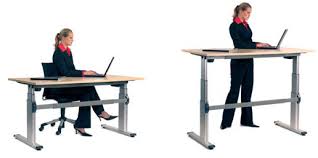 As the name suggests, the sit-stand desk is a desk fitted with hydraulic legs which can be raised when an employee wants to work standing up and lowered when an employee wants to work sitting down. The hydraulics are either electricity-powered or battery-powered. The desk tops themselves range from a simple table top in various geometric shapes to a traditional full-sized desk or workstation.
The sit stand desk is one piece of office furniture that offers many advantages.
- It is ergonomically friendly. Employees have the option of changing their position while they continue working. This reduces stress on their backs and legs, and promotes healthy blood circulation.
- It can be sized to fit in any workspace.
- It can be instantly mobile. Most sit-stand desks have wheels for easy mobility if one needs to move their desk from one location to another within the work day.
- They can be geometrically designed to fit with other similar desks to create an instant collaborative work area when needed.
- It can be easily height-adjusted by the push of a button.
Sit-stand desks are just one of the latest and greatest in office furniture offering increased flexibility for your employees.
REIT’s and Real Estate Developers Strategy for 2015
According to the Emerging Trends in Real Estate 2015 Report issued this past December, one significant trend we should expect to see in Canada’s real estate markets include increased mixed-use development in the cores of downtown city areas.
Here’s why.
Two-thousand-and-fourteen (2014) saw a steady influx of people moving into cities across Canada in efforts to have easier access to work and play. Realizing this flow, businesses in various industries decided to follow. With all this activity, the demand for commercial and residential real estate in city cores has steadily increased.
Real estate developers and REITS see the demands and are responding. Fuelled by an increase in investment funding from both domestic and foreign investors, developers such as Bentall Kennedy LP, Kingsett Capital and Allied Properties REIT are looking into core areas of robust cities across Canada to acquire properties and turn them into mixed-used developments. This creative solution not only meets commercial and residential real estate demands simultaneously, but also increases the value and attractiveness of the properties to existing and potential tenants.
But not every REIT is following the mixed-use development plan. With a focus on credit quality, True North Commercial REIT, for example, has put its focus on acquiring office buildings housing government and other rated tenants with long term leases and has no intention of adding a residential area to those buildings. Its residential component, True North Apartment REIT, will continue to focus on acquiring apartment housing in both Canada and the United States with the strategy of promoting them as affordable housing options.
The real estate developers following the mixed-use development plan will need to design or redesign their properties to appeal to both the residential tenants looking for convenience in every area of the lifestyle they seek, and the commercial tenants trying to attract them.


Permit Grade Design: The Real Deal
One of the biggest mistakes businesses make when choosing an office space designer is basing their decision on a conceptual drawing or a block floorplan of an office space simply because they assume that the block floorplan is the exact way their completed office will be when the job is done. Not the case. While a block floorplan has its merits, the real decision-making factor is in the Permit Grade Design.
Similar to a block floorplan, a Permit Grade Design is a ceiling-view drawing of an office space with its different subsections blocked in—workstation area, closed in office areas, exits, washrooms, elevators, stairs, furniture, etc. However, the Permit Grade Design is drawn to scale based on the exact measurements and layout of your office space and furniture. With a Permit Grade Design, businesses and decision-makers will have a clearer view of what the final layout of their office space could look like. Presented with various Permit Grade Designs, businesses can make a more educated decision on which office space designer to hire and get the job done based on the best floorplan presented to them.
Permit Grade Designs are easy to obtain—just request one from the office space designer(s) you are considering to hire. In the short term, it may cost you a little money upfront to account for the extra time the designer takes to measure every aspect of your office space and furniture, but it would prove beneficial in the longer run because (a) you will gain a greater confidence in the office space designer you choose to hire, and (b) you will minimize the possibility of some common and sometimes costly problems such as furniture not fitting properly into their assigned office areas .
So, when it comes to hiring an office space designer based on a floorplan, remember that the Permit Grade Design is the real deal-maker!

Don’t Be Fooled by a Block Floorplan!
There are many main factors that come into play when choosing a designer to create and “build” your ideal office space—three of which are pricing, personality and the plan (floorplan that is).
Pricing: This is obvious. You want the best quality for the lowest cost possible (the best bang for your buck).
Personality: Relatively obvious. You want someone who works compatibly with you and your team while working towards realizing your ideal office space.
The Plan: Deceivingly obvious. The designer that presents the most favorable looking floorplan is likely to be the professional you will want to choose. That is the premise most decision-makers bank on. However, many fall into the trap of making their final decision on the wrong floorplan.
Let me explain.
Designers vying for your business will likely present you with a block floorplan. As the name suggests, a block floorplan is a ceiling-view schematic drawing of an office space with sections “blocked” on the page to represent individual office and workstation areas, bathroom spaces, stairways, elevators, exits, etc. Some block floorplans may even include top-view drawings of furniture such as a desk or a sofa just to give an idea of furniture placement within each blocked space. Block floorplans are great for providing a conceptual view of how your office space could be laid out, but they do not represent an exact view of your office space simply because they are most often not based on the actual measurements of both your office layout and your furniture.
Now, a block floor plan does have additional benefits: it can reveal to a decision-maker what a designer is capable of creating and may even give some insight to the question of whether or not the designer can identify with your business needs in relation to your office space. However, as a cover letter is with a resume, a block floorplan should be seen as part of an introduction to a designer who could potentially provide a solution to your office space– not as the actual solution to your office space.
Block floorplans may help narrow your choices of designers to use for your office space, but the real determining factor would be in the permit grade design…but we will discuss that in another blog.
 Corporate Space Planning & Relocation Advice