
Uncategorized
The Power of “Thank You”
 Thank you–It’s a phrase that can easily be taken for granted, especially in business, but when it is said or expressed in a timely and relative fashion to colleagues, employees or even clientele, it creates a wave of positive results for a business:
“Thank you” encourages your best employees to continue being the best…or get even better. Whether they come up with a really innovative idea, or follow through on a project or close a sale, saying or expressing a “thank you” will encourage the recipients to do even better next time, and maybe surrounding employees to achieve the same thus ensuing a positive effect on employee performance.
“Thank you” helps companies keep the best employees. A business that cultivates “thank you” as part of its culture or environment will encourage its best employees to stick with them and not veer towards the competition.
“Thank you” improves business performance. With your employees feeling appreciated, business productivity could easily increase or improve. Deadlines and business opportunities would likely be achieved more often instead of missed.
“Thank you” encourages repeat business, especially if a client’s needs were met or exceeded the first or previous times.
Heck, I’ll even go as far to say that based on all the above, “Thank you” can have a direct positive effect on your bottom line!
Saying or expressing a “thank you” does not need to be expensive, but it does needs to be
- Timely – said at or as close to the time the event or action being thanked for has taken place,
- Specific – expressed in direct relation to the exact event, action or result being thanked for, and
- Relative to the recipient(s) receiving the “Thank you”. There are many ways to say “thank you” — cards, public recognition, gift certificates, awards, luncheons, social media recognition, etc—but not every way works effectively for everyone. Get to know your employees, and you will know how to best say “thanks” to them when they do something that helps achieve your business goals.
Most importantly, saying “Thank you” needs to be a carefully crafted business strategy that when done well, can give a business a competitive edge in the marketplace.
…………………………………………………………………………………………………
DJ Mcgauley and Associates Inc. is your Office Space Planning, Renovations and Relocation Project Management Company of choice. If a renovation or relocation of your office space is in your plans, please contact us to arrange a no-obligation site meeting. By the end of that meeting, you will know all that would be required to make your office renovation/relocation project a successful reality.
Call 416-239-1931, email [email protected] or visit our website for more information and to complete our contact form.
References:
Leibow, C., Huffington Post, Feb 15, 2014, “The Power of Thank You”, http://www.huffingtonpost.com/cathy-leibow/the-power-of-thank-you_b_4441454.html
Peters R., Standard of Trust, Dec 30, 2015, “5 Key Employee Recognition Trends in 2016”, https://www.linkedin.com/pulse/5-key-employee-recognition-trends-2016-rob-peters
Heathfield, S.M., The Balance, Aug 11, 2016, “The Power of Positive Employee Recognition”, https://www.thebalance.com/the-power-of-positive-employee-recognition-1919054
Key words: Thank you
Tags: thank you, employee recognition, office culture, office environment
5 Elements That Help Bring Nature Into Your Office Space
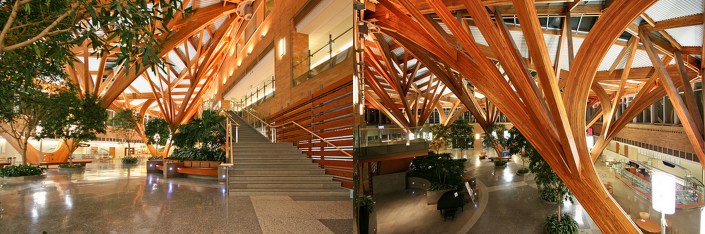
April 22nd was Earth Day, a day in which people were reminded to protect, value and maintain the environment. For some, it meant planting a tree or two. For others, it was a reminder to go green by consuming less energy, utilizing renewable energy or choosing less pollution-inducing ways to travel from one location to another. For the office space design world, however, it is an ever developing trend to find different ways to bring nature into the immediate work environment.
Here are just five elements of nature that have inspired office space design specialists to incorporate the outdoors into an office space design:
- Living plants – From potted plants to entire gardens, living plants have been the most common used elements in bringing the outdoors into an office space design.
- Moving Water – The movement or flow of water is said to have tranquil calming effect on people who need to take time to clear their minds and prepare for new tasks. Hence, water in the form of small pools, fountains and/or waterfalls has been another element commonly used to bring both the sights and sounds of nature into an office space design.
- Wood and/or stone materials – Whether it is in the panelling, the floor, the furniture, the accessories, or a major part of the architecture, natural wood or stone finishes are becoming more and more popular in office space designs.
- Patterns and textures of nature even in the non-nature items – Sometimes fabrics or artwork with pictures or patterns from nature, or the use of “golf green” in certain areas of an office space has been used as an effective way to incorporate nature into an office space design.
- Life itself – Though not for every office, creating an enclosed area where small birds can fly and sing freely or fish can swim has been used to effectively create an outdoor nature experience within an office space design.
Companies and design specialists recognize the invaluable relationship between nature and people. Humans are more productive, creative and innovative when exposed to a natural environment, maybe because of the increased oxygen levels or the calmness and tranquility it imposes on the mind. Nature comes alive when humans recognize and take care of it. Hence, bringing this “eco-system” into an office space design makes sense, especially for companies wanting to have the cutting edge within their industries.
……………………………………………………………….
DJ Mcgauley and Associates Inc. is your Office Space Planning, Renovations and Relocation Project Management Company of choice. If a renovation or relocation of your office space is in your plans, please contact us to arrange a no-obligation site meeting. By the end of that meeting, you will know all that would be required to make your office renovation/relocation project a successful reality.
Call 416-239-1931, email [email protected] or visit our website for more information and to complete our contact form.
Merry Christmas and Happy Holidays From DJ McGauley & Associates Inc.
…………………………………………………
DJ McGauley and Associates Inc. is your Space Planning, Renovation and Facilities Management company of choice for the Toronto, GTA and surrounding areas. If an office move or reconstruction of your 2,000 – 25,000 sq.ft. office space is in your plans, contact us to arrange a no-obligation site meeting. Our friendly experienced team will work seamlessly with your staff to guide you through the process, allowing your employees to enjoy a productive, stress-free experience.
Call 416-239-1931 , email [email protected], or visit our website to complete our contact form.
Permit Grade Design: The Real Deal
One of the biggest mistakes businesses make when choosing an office space designer is basing their decision on a conceptual drawing or a block floorplan of an office space simply because they assume that the block floorplan is the exact way their completed office will be when the job is done. Not the case. While a block floorplan has its merits, the real decision-making factor is in the Permit Grade Design.
Similar to a block floorplan, a Permit Grade Design is a ceiling-view drawing of an office space with its different subsections blocked in—workstation area, closed in office areas, exits, washrooms, elevators, stairs, furniture, etc. However, the Permit Grade Design is drawn to scale based on the exact measurements and layout of your office space and furniture. With a Permit Grade Design, businesses and decision-makers will have a clearer view of what the final layout of their office space could look like. Presented with various Permit Grade Designs, businesses can make a more educated decision on which office space designer to hire and get the job done based on the best floorplan presented to them.
Permit Grade Designs are easy to obtain—just request one from the office space designer(s) you are considering to hire. In the short term, it may cost you a little money upfront to account for the extra time the designer takes to measure every aspect of your office space and furniture, but it would prove beneficial in the longer run because (a) you will gain a greater confidence in the office space designer you choose to hire, and (b) you will minimize the possibility of some common and sometimes costly problems such as furniture not fitting properly into their assigned office areas .
So, when it comes to hiring an office space designer based on a floorplan, remember that the Permit Grade Design is the real deal-maker!
Avoiding the Inadequate Internet Service Post-Move Growing Pain
So, you found your office space. You move in. After all the furniture is in place, you sit down in front of your computer to try to get online, only to find that the internet service is not available or that it is very slow. What could be happening? How could this issue have been avoided?
Similar to the phone service, your internet service provider will need ample notice of your intent to move, the future address, and the move date as well as your company’s specific internet needs at the new location in order to ensure the internet service is activated once you move in and is adequate to meet the demands of your business operations.
An optimally running internet service would be contingent on at least two things:
- The capacity of the internet line servicing your specific location.
- The actual amount of traffic the internet line handles at any given moment due to the number of other organizations or entities sharing that line.
Hence, when in contact with the internet service provider, it is important to find out the maximum amount of traffic the internet line servicing your new location can handle as well as the maximum amount of traffic the line has handled within the last six months. Compare the difference with the maximum amount of traffic your organization could potentially put on that line. If your organization’s internet service demand is greater than the resulting difference of the above, then you may want to request that either a separate dedicated internet line be installed for your business’ use only or that fiber-optic communication lines (which are capable of transmitting over 100,000 terabits of information) be scheduled for installation in the area of your new location.
Using the above suggestions, the chance of having a bogged-down internet system inhibiting your business operations can be avoided.
6 Ways To Protect Your Business Before Disaster Strikes
Financial expertise may not be the scope of our business, but with the hit of severe ice storms, like the one that hit Toronto and its surrounding areas in December 2013, and heavy rains that caused flooding just five months earlier in the same city, we have seen businesses take a hit to their profits as a result of extended periods of lost power, damages to their commercial properties, and damages to their equipment and building’s infrastructure. While profits are being spent on mending the damages, extreme weather conditions may be lurking around the corner just waiting to create more problems.
So what can businesses do to protect their property and thus protect their profits in the event of impending disasters? Here is a tip or two to consider:
Tip #1 – Get access to a backup generator. Whether your organization chooses to purchase a generator or purchase space from the landlord’s existing generator, having access to a backup generator allows your company to remain in operation if the main electrical system fails.
Tip #2 – Ensure all computer files are backed-up daily on a tested online or offline back-up system. Some companies may already have a backup system, but amazingly enough, not all of those backup systems are tested and many fail in the event of an emergency or disaster. Whether you choose an online or offline back-up system, take a moment to confirm your files have been backed up and are easily retrievable. If your server goes down, a tried and true back-up system, such as a tape drive or using data striping on multiple hard drives, will help your company quickly retrieve files and resume regular business activities once the server is back online, thus saving time and money.
Tip #3 – Make sure your servers are placed in a rack that is bolted to the wall and elevated a minimum of seven and a half centimetres off the floor. This would protect your server from damages in the event of a flood.
Tip #4 – Install sensors in ceilings and floors that will send off an alarm if excess moisture is building up on your pipes. Also office appliances such as coffeemakers should contain sensors that will trigger the “off” mechanism if an overflow begins. All this would prevent moisture damage to floors, ceilings and walls.
Tip #5 – Make sure you and your staff are aware of emergency exits and procedures. Plan your exit strategies and have fire drills so everyone becomes familiar with the actions they should take during any emergency. Your most valuable assets are your staff. Take care of them and they will take care of your business.
Tip #6 – Make sure all emergency equipment is regularly checked and up to date. This includes alarms, detectors, fire extinguishers, and first aid kits. Having these up to par will go further in protecting all your profit- generating assets.
Following any or all of these tips will certainly limit the negative effects any disaster could otherwise have on your business.
T’was the week before moving day…
(The following poem is dedicated to all the businesses that are planning to relocate to a new office space in and around the holiday season.)
T’was the week before moving day
And all through the office
Everybody was scurrying
Including the bosses
There were lots to be done
To move from old place to new
But where to start
Nobody knew
So they called in a specialist
To address their quandary
Who would help them get ready
On time, budget and with little worry
“To ensure your move goes without any stress
There are 12 things that you need to address
Twelve tasks that are commonly forgotten
When companies choose to move to a new location
First, at the new space, identify
Where cable and electrical outlets lie
Then clearly define what will go where
Based on actual furniture and items that will move there
The next two tasks involve telling third parties
Of your new address and the date you will occupy it
Inform your postal service to reroute your mail
And your phone company so new phone lines won’t fail
Next is the packing but before you do
Take personal valuables home with you
Then determine what items need to be trashed
And whatever is leftover is what you should pack
Label all items that will be moved
With name and station number they should be moved to
Leave nothing amiss, not a lamp, not a chair
So the movers can deliver your items right there
Scheduling IT is the next thing to do
To disconnect at the old space and reconnect at the new
Your telecommunications system should be moved and tested
By a specialist that will ensure they perform at their best
Finally, confirm that your company name
Will be listed on the signage of your new domain
Both at the entrance and on your suite floor
So stakeholders can be easily led to your door
With all the above done, you’ll be in good shape to move
To leave the old place and embrace the new
When all is in place to meet operation needs
All that will be left is for your business to succeed.”
Changing Office Furniture? Go Modular.
Choosing the right furniture for your office space is not only important but essential for the success of your company. Why? Because the right office furniture ensures the comfort of your staff and encourages their productivity. But when you have to balance the different needs and preferences of your staff with your organization’s goals and image, what type of office furniture should you choose? We suggest modular office furniture. Here are a few reasons why:
By definition, modular office furniture is actually pre-made furniture units, including desks, chairs, storage cabinets, workstation units and wall partitions that can be combined and arranged in different configurations to furnish an office or establish a workspace. Much like the pieces of a puzzle, the modular office furniture units may vary in shape and size, however they are made in such a way that any combination of the pieces can be put together to create a unique and private work space for each individual employee, establish a collaborative team environment, or both (i.e. a collaborative team environment while respecting the individual workspace needed for your people to work optimally )—whatever is needed to get the most out of your employees and meet your organizational goals. In addition, some units can be designed to be ergonomically friendly. Talk about getting the best of both worlds!
Another reason why we recommend modular office furniture is because of its flexibility and adaptability to the actual office space and, of course, mobility if that office space changes. In other words, a set of modular office furniture units, particularly workstations, can be arranged one way for closed-in office space, and re-arranged another way in an open area — each arrangement optimizing the use of the workspace at hand.
A third reason for recommending modular office furniture is that it can be budget friendly. Modular units range from inexpensive cubicle units to more expensive executive furniture units. The furniture pieces purchased can be limited to the pieces needed to create an optimal workspace for your employees in order to stay within any budget constraints. Additional pieces can be added at a later date if your budget permits and the need arises.
A fourth reason for recommending modular office furniture is that it is environmentally friendly. Many modular office furniture units are made out of recycled materials. You would know by the LEED (Leadership in Energy and Environmental Design) Certification stamp found on each unit.
Finally, in general, they are made to last! There are very few cases where a modular unit would need to be replaced or repaired due to damage.
Flexibility, adaptability, cost-effectiveness, environment friendliness and durability, plus no compromise on professional looks—all good reasons why modular office furniture should be your organization’s first choice for furnishing an office space.
What Does Your Reception Desk Actually Say To Your Visitors?
Don’t Be Fooled-DIY Office Renos and Office Moves Can Add to Your Operational Expenses
Ok. So your business needs to undergo some form of physical change to remain competitive in its market –maybe an office “facelift” or maybe an expansion into a new office. Whatever your decision, you know you don’t want to incur too many additional expenses to have your office renovated or moved. You decide that you and your employees will be able to do the work on your own with little, if any, external help.
At first glance this might seem like a viable option. After all, your expenditures wouldn’t go to interior designers or consultants, and if moving, you may only need to rent a truck especially if your staff does all the packing. Big savings, right?
Wrong. You may not realize it, but DIY office renovations and office moves can actually add hidden costs to your operational expenses.
How? Glad you asked.
First, let’s consider the term “operational expenses”. By definition, operational expenses are “day-to-day expenses incurred in the normal course of business”1. In other words, operational expenses are the moneys spent to keep your business functioning each day, every day. This includes materials as well as labour costs. While DIY office renovations or moves may not have a direct affect on some operational expenses, they would have a direct effect on others. For this blog, let’s focus on the effect on labour.
According to Statistics Canada, the average hourly labour wage for in August 2013 is $23.86 per person2. Based on a 40-hour week, that translates into an operating expense of $954.40/person/week. Multiply that by the number of staff you have in your company and you have your weekly operational expense for the labour category. (For the sake of the chart below, let’s assume a staff of 150 people) You pay those staff to do particular jobs that propel the functioning of your company. Imagine taking those same staff and redirecting their attention to fulfill office renovation or move tasks. Your physical operational expense for labour will not change, but the time taken away from your staff to do the job(s) you originally hired them to do add at least one hidden cost—the cost of their jobs not getting done! This may lead to
- Your overall business operations being placed on hold
- Delays in production or project completion
- Missed business opportunities (new and recurring)
- Loss of business to your competition
- Increased risk of consumer or stakeholder dissatisfaction
- Overworked staff
Place a dollar value on each of the above and sum it up. You may find that the total hidden cost of DIY office renovation or move adds up to millions, maybe even billions of dollars—at least 10 times the cost of hiring a space planning and relocation specialist firm to do the full job for you.
So do your business a favour. Don’t risk adding hidden costs to your operational expenses in the face of an office renovation or move. Instead take time to contact a space planning and relocation specialist in your area and have them do the job. It will actually save you time and money.
References:
1 Investing Answers Financial Dictionary, “Operating Expense”, http://www.investinganswers.com/financial-dictionary/financial-statement-analysis/operating-expense-2792
2 Statistics Canada, “Average hourly wages of employees by selected characteristics and occupation, unadjusted data, by province (monthly)”, http://www.statcan.gc.ca/tables-tableaux/sum-som/l01/cst01/labr69a-eng.htm
- ← Previous
- 1
- 2
- 3
- Next →
 Corporate Space Planning & Relocation Advice